In this article
What was the laser used for?
Laser processed is an incomplete description of a diamond. The equipment might have helped shape the rough, added a report number, or been used in a clarity treatment. Those operations answer different needs and should not be bundled into one claim about quality.
A useful explanation names the operation first. Ask what was done to the diamond, where the operation took place, and why it was performed. Then ask what record supports the answer. Someone describing an inscription should be able to discuss the inscription; someone describing treatment should address the treatment.
The distinctions are worth learning because the same word can sound reassuring in one conversation and concerning in another. Precision describes an intended level of control. It does not tell you whether the operation was for identification, shaping, or changing an inclusion's appearance.
Lasers in cutting and shaping
Lasers have a documented role in turning diamond rough into polished gems. Akiva Caspi's article in the Summer 1997 issue of GIA's Gems & Gemology describes laser sawing and laser bruting among manufacturing technologies. The article is a historical technical account, not a description of every factory operating today. [3]
GIA's later field report from a visit to Chow Tai Fook's Foshan factory describes laser sawing and the use of lasers to form outlines for fancy shapes. The same report also describes conventional bruting equipment for round stones. Even within that one factory, the tool depended on the operation being performed. [4]
One sawing system in that report guided the beam through a narrow water jet. The water helped cool the surface and carry away carbon vapor from the cut. This is a description of the machinery GIA observed, not a feature to assume for all laser equipment. It gives a concrete example of why the surrounding process matters as well as the beam. [4]
For a reader evaluating a finished stone, the practical lesson is to ask about the result that matters. If a seller mentions laser cutting, you can still ask about the diamond's dimensions, finish, and any assessment supplied with it. The fact that a tool was used does not settle how well the completed gem meets your needs.
An inscription helps with identification
GIA describes laser inscription as placing a message, symbol, logo, or report number on the diamond's girdle. Its FAQ says the inscription can be viewed under 10 times magnification and is not visible to the naked eye. The purpose can be identification or a personal message. [1]
A report number gives you something specific to check. Ask the jeweler to show the inscription where accessible and compare it with the document supplied. Look at the issuing laboratory and the document's description of the stone. If anything does not match, resolve the discrepancy before relying on it.
A personal inscription and a laboratory report number have different meanings. A message commemorating an occasion is not a laboratory assessment. Even a report number must be read alongside the report; the inscription alone does not communicate the diamond's color, clarity, or the scope of the examination.
If the inscription is difficult to view in the finished piece, ask the jeweler how the identification is supported. Do not infer that a stone lacks documentation merely because you cannot read a tiny mark yourself.
Clarity treatment has a different purpose
In the laser drilling treatment described by GIA, a laser creates a tiny channel to an internal inclusion. The channel allows a bleaching agent to reach and lighten a dark inclusion. GIA treats the resulting drill hole as a clarity characteristic. Changing the appearance of an inclusion does not make the channel disappear. [2]
The same GIA explanation distinguishes drilling from fracture filling, in which another substance fills fractures. It notes that some drilled stones may also be fracture filled. These are separate descriptions, so a seller should identify which treatment is present rather than using laser treatment as a catchall. [2]
This terminology does not establish that a diamond received clarity treatment whenever a laser was involved in manufacturing. An inscription on the outside and a treatment intended to alter an internal inclusion have different purposes. The answer for a particular stone needs evidence about that stone.
When treatment is disclosed, ask for the relevant documentation and care instructions before deciding. The technical name should help you understand what happened, not become a reason to skip the explanation.
How this relates to a clarity assessment
GIA's description of its grading process explains that graders examine clarity and finish characteristics, and look for evidence of treatments, including laser drilling and fracture filling. Clarity assessment involves examination under specified viewing conditions, rather than a conclusion drawn from the name of a machine. [5]
A statement that equipment is precise is therefore different from a statement about a laboratory result. If a seller claims a particular clarity outcome, ask which document or examination supports it. An educational source describing an industry process cannot supply a missing result for a piece in a showroom.
Keep the document's subject in mind, too. A record about a diamond does not automatically assess the chain, clasp, or complete necklace. Questions about the finished assembly need answers about that assembly.
Three descriptions that should not be confused
Imagine three hypothetical listings. The first says a diamond has an inscribed report number. Your next step is to examine the report and check how it relates to the stone. The useful question concerns identification and the information in that document.
The second says laser sawn. That describes a manufacturing operation. Ask for the characteristics of the finished diamond and examine the piece; the tool name does not tell you whether you prefer its proportions or appearance.
The third discloses laser drilling to alter an inclusion. Here the questions concern treatment, its documentation, and any relevant care requirements. Treating this listing as though it only described an inscription would miss information that could affect the decision.
These examples describe different uses of language, not three Floating Diamonds products. They show why a useful seller explanation starts with the operation instead of relying on the word laser to do all the work.
Explaining our own design
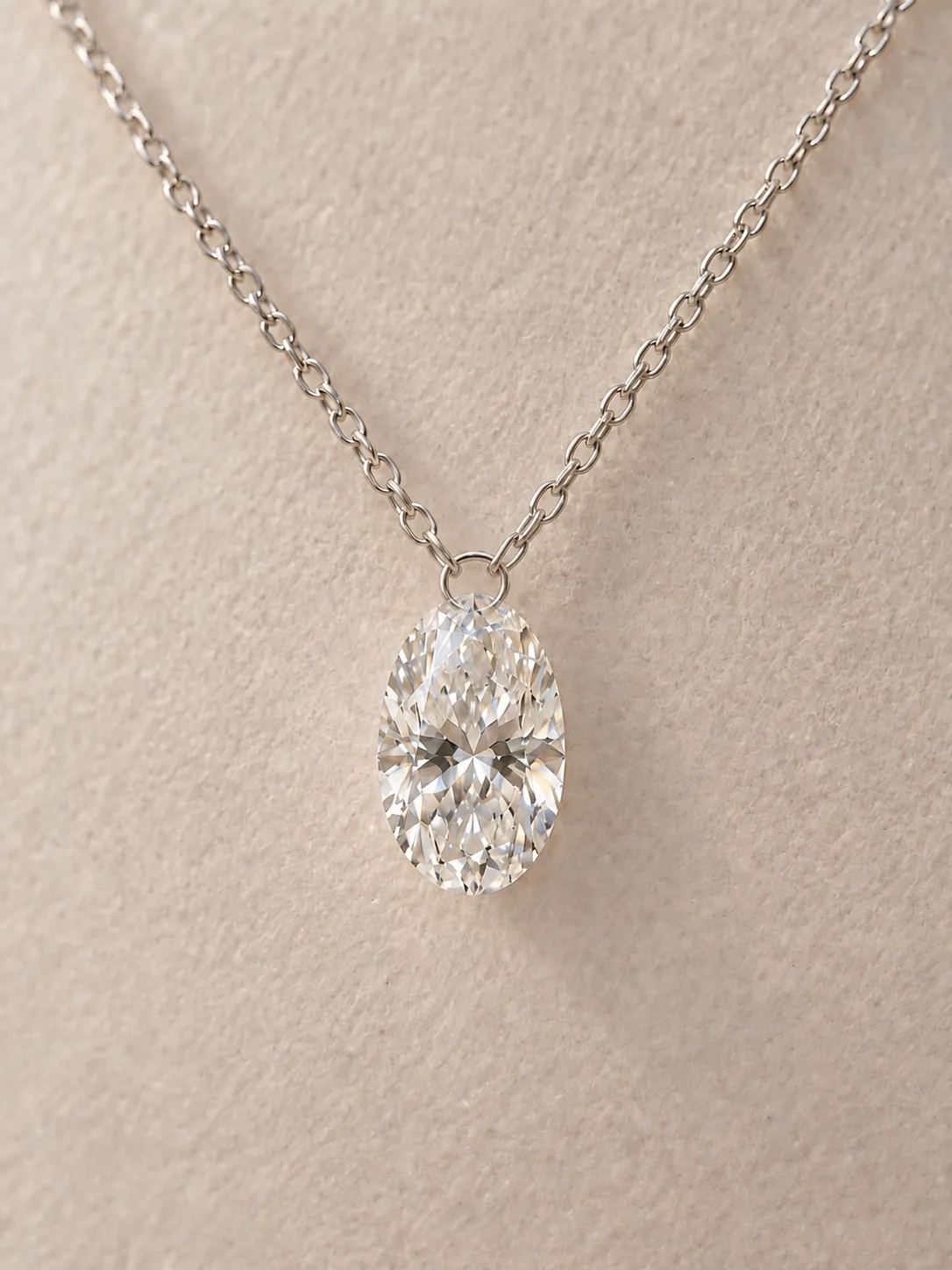
With Floating Diamonds, the traditional setting and prongs visually disappear so the diamond appears to float. That describes the appearance of the finished design. A person asking how the necklace is constructed needs an answer about construction, rather than another description of how it looks.
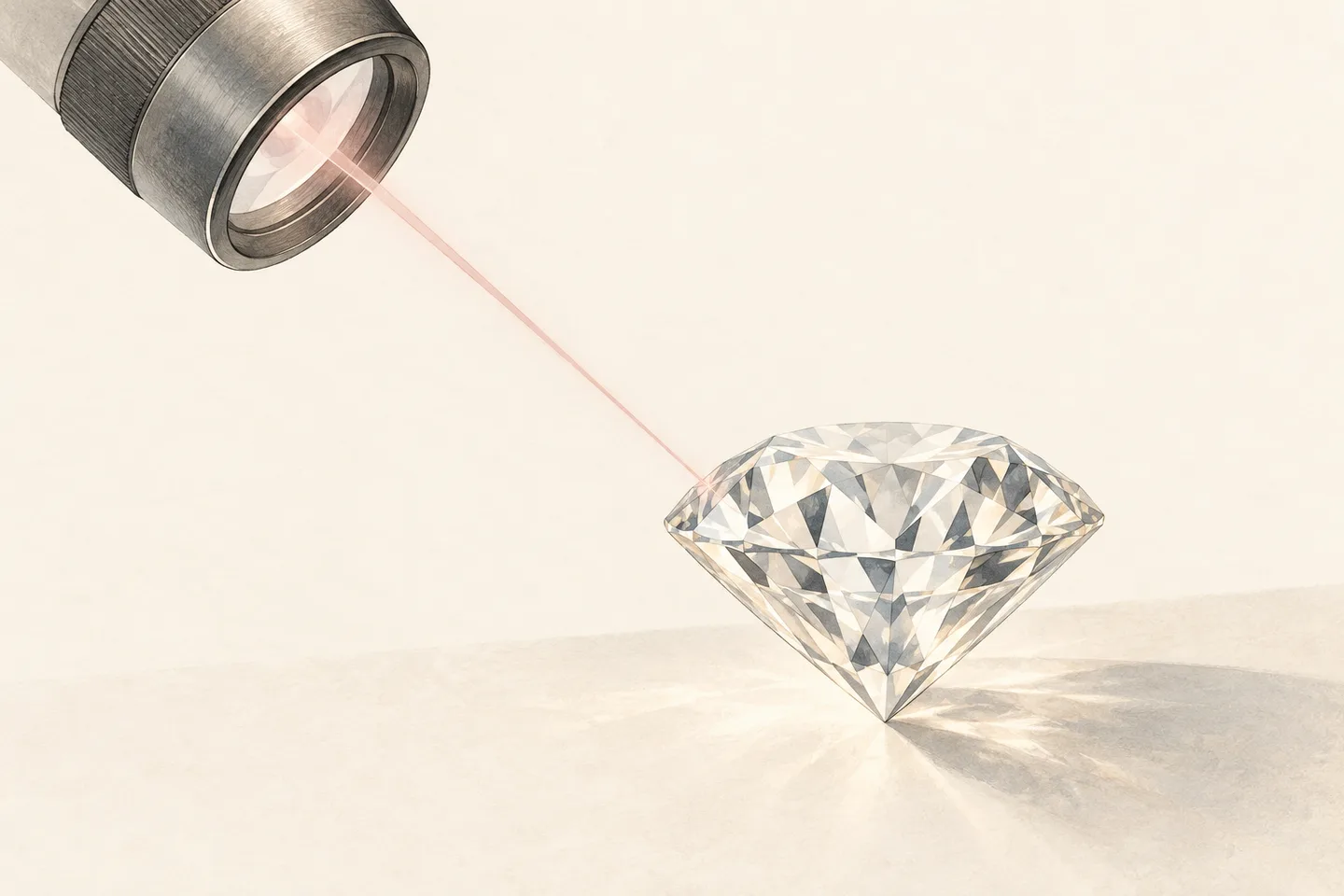
We keep that distinction when discussing industry technology. A GIA article about laser treatment is not a test of our necklace. The illustration on this page is conceptual, not a depiction of our equipment or proof of a manufacturing result. Ask about the exact piece if you need construction details or supporting documentation.
What to ask before relying on a claim
Begin with one direct question: what was the laser used to do? Once that is clear, ask what evidence supports the specific result being claimed. A report, a manufacturing explanation, and an examination of the necklace serve different purposes.
If the claim concerns strength or lifespan, request evidence relevant to strength or lifespan. If it concerns clarity, ask about the actual assessment. Keep unresolved questions open until the seller answers them; neither enthusiasm for the technology nor concern about the word laser can substitute for those answers.
Sources & context
These GIA sources describe industry uses of lasers. They do not establish grading, treatment history, durability, or certification for a Floating Diamonds piece.